From Monitoring to Modelling: Edwyn Andrés Explains UrbanM2O’s Barcelona Case Study
How can innovative monitoring and modelling technologies help cities better manage groundwater resources and respond to growing water scarcity?
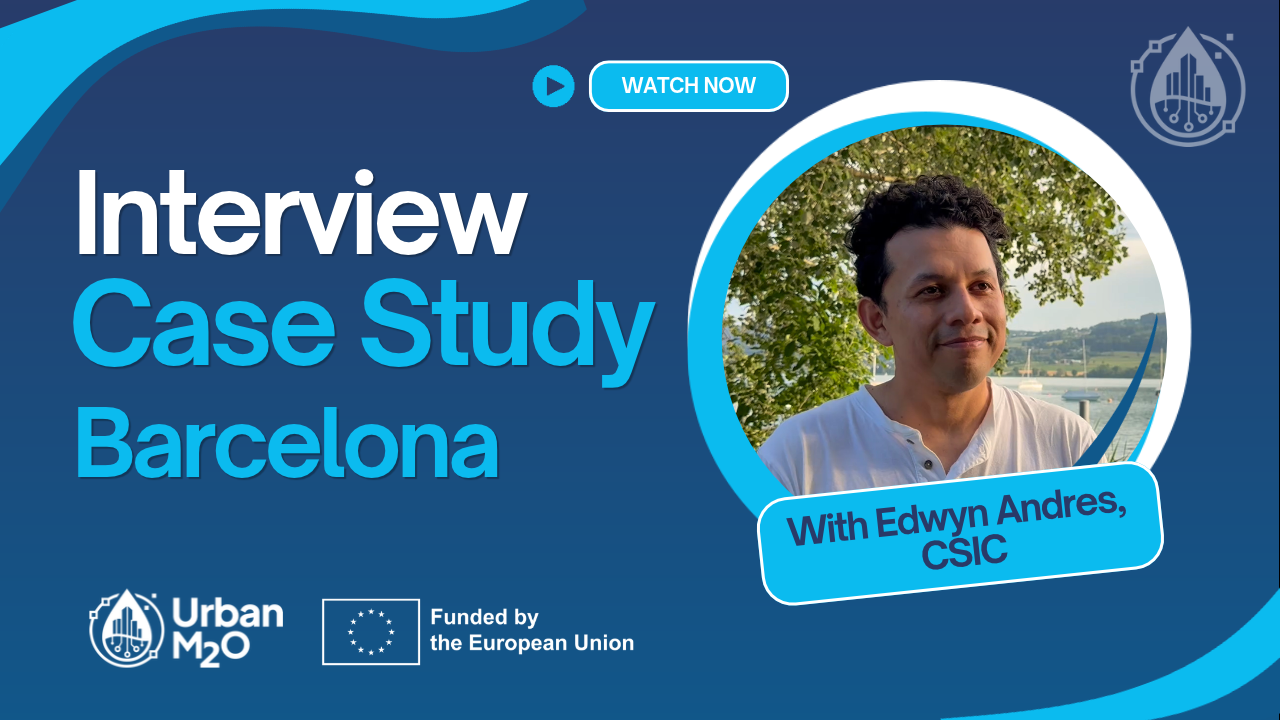
In our latest UrbanM2O interview, Edwyn Andrés Pérez Ortiz, researcher at the Institute of Environmental Assessment and Water Research (IDAEA-CSIC), part of the Spanish National Research Council (CSIC), introduces the activities underway at the project’s Case Study 1 in Sant Adrià de Besòs, located in the Barcelona metropolitan area, Spain.
During the interview, Edwyn explains how the project is collecting groundwater monitoring data and developing modelling tools to improve understanding of urban groundwater systems and support more sustainable water management.
Addressing Water Scarcity in the Barcelona Metropolitan Area
Water scarcity represents an increasingly important challenge for Barcelona and its surrounding metropolitan area, where pressure on conventional drinking-water resources is driving the need to explore alternative sources and improve resource management.
Within this context, UrbanM2O’s Barcelona case study focuses on better understanding groundwater conditions and exploring how this resource could contribute to addressing local water challenges.
However, groundwater management in densely populated urban areas presents several challenges, including pollution risks associated with industrial activities, urban drainage infrastructure and interactions with surrounding water bodies.
To address these challenges, UrbanM2O is combining monitoring technologies with innovative modelling approaches to generate more comprehensive information about groundwater resources.
From Groundwater Monitoring to 3D Modelling
During the interview, Edwyn Andrés explains his involvement in collecting and analysing data from piezometers installed in the Sant Adrià de Besòs case study area.
These monitoring activities provide important information about groundwater conditions and contribute to improving knowledge of how groundwater behaves within a complex urban environment.
One of the expected outcomes is the development of a three-dimensional (3D) groundwater model, which will integrate monitoring data to provide a more detailed understanding of the local groundwater system.
The model is intended to support the assessment of groundwater conditions and help researchers and water managers make more informed decisions regarding the management of this resource.
By combining field measurements and modelling technologies, the project aims to strengthen the evidence available for urban water management and contribute to developing more resilient water systems.
Developing Solutions for Other European Cities
Beyond the Barcelona case study, the research also aims to generate knowledge and tools that could be transferred to other metropolitan areas facing similar water challenges.
As Edwyn highlights in the interview, pressure on drinking-water resources is not limited to Barcelona but represents a growing concern for cities across Europe.
Through its three European case studies, UrbanM2O is developing and testing innovative monitoring and modelling solutions to improve urban water-quality management, support data-driven decision-making and contribute to more sustainable and climate-resilient cities.
Watch the full interview with Edwyn Andrés Pérez Ortiz to learn more about the research activities taking place in Sant Adrià de Besòs and the expected contribution of the Barcelona case study to improved groundwater management.